

When people think about saving electricity, they often focus only on switching off fans, air conditioners, or appliances. But lighting is one of the easiest places to cut waste, especially in areas where lights are left on by mistake or used only for short periods. That is where Sensor LED Lights make a real difference.
Instead of burning electricity all day, these lights turn on only when movement is detected and switch off after a set time. That simple change can reduce energy waste, improve safety, and lower monthly bills. In homes, offices, shops, and outdoor spaces, Sensor LED Lights are becoming a smart choice for people who want convenience and long-term savings.
In this article, we will look at the 7 best places to install Sensor LED Lights, how they help, where they work best, and what to consider before installing them.
Why Sensor LED Lights are worth using
Before going into the best locations, it helps to understand why these lights are so useful.
- They save electricity by lighting only when needed.
- They reduce the chance of forgetting lights on.
- They improve safety in dark or low-traffic areas.
- They are easy to use in both homes and commercial spaces.
- They can reduce long-term electricity costs in Indian households and businesses.
A small investment in the right place can create noticeable savings over time. In many cases, Sensor LED Lights pay for themselves through reduced power consumption.
1. Staircases and stairwells
Staircases are one of the smartest places to install motion-based lighting. People usually pass through stairs quickly, which means lights are needed only for a short time. If staircase lights stay on all day or night, that is pure energy waste.
Sensor LED Lights are especially useful here because they can turn on automatically when someone starts using the stairs and turn off after the person leaves.
Why staircases are a great choice
- Stairways are used often but not continuously.
- They improve safety at night.
- They reduce the chance of tripping or falling in the dark.
- They save more power than lights in rooms that stay occupied for longer periods.
Best placement tips
- Install the sensor at a height of about 2.5 to 3 metres.
- Place it where it can detect movement from both the top and bottom of the stairs.
- Avoid placing it behind beams or corners where movement may be blocked.
Things to remember
- Use a delay time that is not too short.
- If the sensor turns off too fast, it may feel annoying.
- For stairwells, a dimming option is often better than complete darkness.
Staircases are one of the highest-return areas for Sensor LED Lights, both for safety and energy savings.
2. Hallways and corridors
Hallways often have a big problem: lights stay on even when nobody is there. In homes, offices, hospitals, apartment buildings, and hotels, corridors can waste a lot of electricity because people walk through them only for a few seconds at a time.
This is one of the best places for Sensor LED Lights because the usage is short, repeated, and predictable.
Why corridors save a lot
- Lights are often left on all day or all night.
- Movement is easy to detect in a narrow space.
- A single sensor can cover a long passage.
- It creates a cleaner and more modern lighting setup.
Placement ideas
- Use ceiling-mounted sensors for even coverage.
- In a long corridor, install multiple sensors instead of relying on one.
- Keep the sensor clear of obstructions like curtains, shelves, or wall decorations.
Common mistakes to avoid
- Do not place the sensor too high if the corridor is narrow.
- Do not place it where sunlight changes may confuse the system.
- Make sure the light delay is long enough for a person to walk through comfortably.
Corridors are one of the most practical places for Sensor LED Lights, especially if your goal is to cut unnecessary usage without affecting comfort.
3. Outdoor entrances, porches, and driveways
Outdoor lighting can consume a surprising amount of electricity, especially if lights stay on for security all night. That is why driveways, porches, garden paths, and entry areas are excellent spots for sensor lighting.
Sensor LED Lights in outdoor spaces help you keep the area bright only when someone arrives or moves through it.
Why outdoor areas are ideal
- Lights are needed mainly for movement or safety.
- They improve security around the property.
- They help visitors and family members enter safely at night.
- They reduce all-night lighting waste.
Best placement for outdoor use
- Mount the light high enough to cover the approach area.
- Angle it toward the driveway, gate, or front path.
- Avoid pointing it directly at roads, passing vehicles, or trees that may trigger it unnecessarily.
Helpful tips
- Choose weather-resistant fittings.
- Use a model designed for outdoor conditions.
- Test sensitivity so it does not turn on too often from small movement outside the target area.
If your outdoor lights stay on for many hours every night, Sensor LED Lights can bring a visible reduction in power use.
4. Garages and parking areas
Garages are another perfect place for motion-controlled lighting. People enter and leave garages only for a short time, so there is no reason to keep lights running for long periods.
Sensor LED Lights work well here because they respond quickly when a vehicle or person enters the space.
Why garages are smart for sensors
- Lights are needed only during entry, exit, or short tasks.
- They improve visibility while parking.
- They are helpful when carrying bags, tools, or groceries.
- They prevent lights from staying on after the garage is empty.
Where to place them
- Install the sensor above the garage door or on the ceiling.
- Ensure the whole parking area is covered.
- If the garage is large, use more than one sensor.
What to watch out for
- Car engines can create heat that may affect some sensors.
- Make sure the sensor is not triggered by the road outside.
- If the garage is attached to the house, test the range carefully.
Garages often offer one of the best balance points between convenience and savings when using Sensor LED Lights.
5. Bathrooms and toilets
Bathrooms are a little different. They do save energy with sensors, but the bigger benefit is comfort and convenience. Nobody wants to fumble for a switch in the dark at night, and motion-based lighting helps solve that.
Why bathrooms work well
- People usually enter for short periods.
- Lights are often forgotten after use.
- It is convenient for children, elders, and night-time use.
- It makes the space feel more modern and easy to use.
Best use case
- Common bathrooms in homes, offices, or guest areas.
- Toilets in commercial spaces.
- Small wash areas where people enter briefly.
Important points
- Do not place the sensor where steam or water splash may affect it.
- Set a delay time long enough for normal use.
- A gentle, reliable sensor works better than one that is overly sensitive.
Bathrooms are not the biggest energy-saving area, but they are still a practical place for Sensor LED Lights when comfort matters.
6. Commercial entrances and shop front areas
Shops, office buildings, clinics, and small business entrances are often busy for a short time and quiet for long periods. That makes them ideal for automatic lighting control.
Sensor LED Lights at commercial entrances help save power while also making the area look safe and active when someone arrives.
Why businesses should care
- Entry lights do not need to stay on all day.
- Customers and staff feel safer when lighting turns on automatically.
- It can create a better first impression.
- It helps businesses cut operating costs.
Best placement
- Put the sensor near the main entry path.
- For outdoor entrances, mount it above the door or under an awning.
- For indoor entrances, place it where it can detect people entering from the main approach.
Common mistakes
- Do not place it where passing traffic can trigger it constantly.
- Keep the lighting angle comfortable and not too harsh.
- Make sure it does not blind visitors at the entrance.
For business owners, Sensor LED Lights are a small upgrade that can support both savings and appearance.
7. Store rooms, utility areas, and less-used corners
This is one of the most overlooked spaces in a building. Store rooms, utility rooms, back corners, and other low-traffic spaces often have lights turned on only because people forget to switch them off.
That makes them a hidden opportunity for Sensor LED Lights.
Why these areas matter
- People enter only for a short time.
- Lights are often left on after use.
- They are easy to improve with motion sensors.
- They help reduce invisible energy waste.
Good examples
- Store rooms in homes.
- Cleaning supply areas.
- Utility cupboards.
- Back-of-house areas in shops or offices.
Best approach
- Use a simple ceiling sensor.
- Keep the range focused on the entry area.
- Set an appropriate delay so the light stays on long enough while someone is inside.
These spaces may seem small, but over time they can add up to a meaningful reduction in electricity use.
Quick comparison table
| Location | Best for | Energy Saving Potential | Suggested Sensor Type |
|---|---|---|---|
| Staircases | Safety + short use | High | Ceiling motion sensor |
| Hallways | Frequent passing | Very high | Ceiling sensor panel |
| Outdoor entrances | Security + convenience | High | Weatherproof motion sensor |
| Garages | Entry and parking | High | PIR floodlight |
| Bathrooms | Convenience | Medium | Small motion sensor |
| Commercial entrances | Business visibility | High | Door-entry motion sensor |
| Store rooms | Forgotten usage | Medium to high | Simple ceiling sensor |
Simple energy-saving view
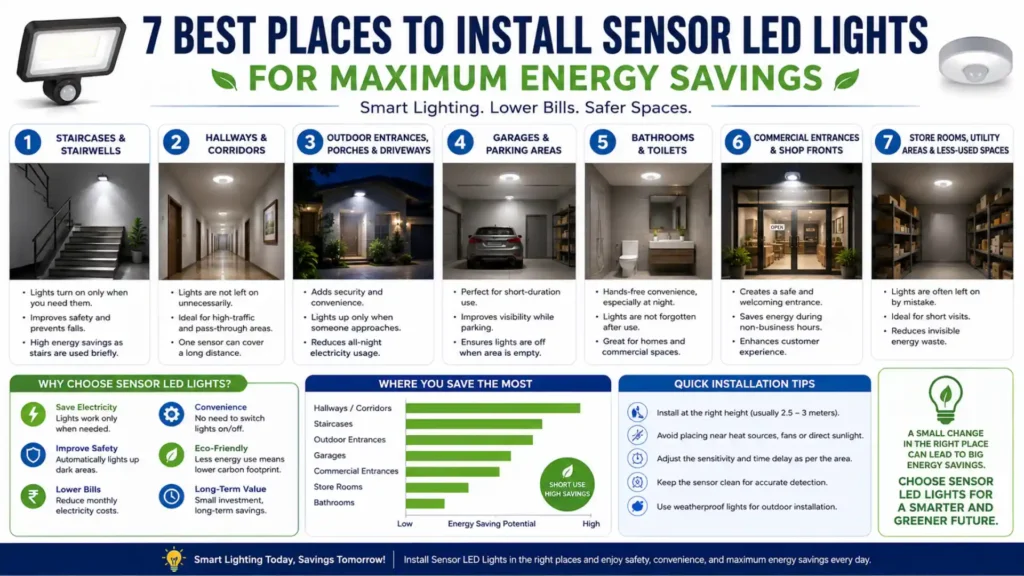
Here is a simple visual comparison of where Sensor LED Lights usually create the most value.
Hallways / Corridors      ██████████
Staircases                █████████
Outdoor Entrances         █████████
Garages                   ████████
Commercial Entrances      ████████
Store Rooms               ███████
Bathrooms                 ███
The biggest savings usually come from places where lights are used often but only for a short time.
How to install Sensor LED Lights properly
Installing them in the right place matters just as much as buying the right product.
Simple installation tips
- Choose areas with movement, not still spaces.
- Keep the sensor away from direct heat or sunlight.
- Make sure the detection angle matches the room shape.
- Test the delay time after installation.
- Clean the sensor and light regularly.
Mistakes to avoid
- Installing them in the wrong room.
- Placing them too high or too low.
- Facing them toward windows or fans.
- Using overly sensitive settings.
- Ignoring weather protection for outdoor use.
The goal is not just to install Sensor LED Lights, but to make them work naturally in daily life.
How much can you save?
Savings depend on the room, the number of hours a light stays on, and the power rating of the bulb or fixture. For example, if a 10W light is left on for several unnecessary hours each day, the yearly waste can add up. In Indian homes and shops, even small reductions can make a difference in the electricity bill.
A basic estimate:
- Short-use spaces save the most.
- Long-idle spaces save the most money.
- High-traffic rooms save less.
- Outdoor and corridor lights often give the fastest return.
For many households, Sensor LED Lights are not just about automation. They are about reducing waste in the places where lights are most often forgotten.
Final thoughts
If you want to save electricity without changing your daily routine too much, Sensor LED Lights are one of the easiest upgrades to make. The best results usually come from staircases, hallways, outdoor entrances, garages, commercial entry points, store rooms, and bathrooms.
The key is simple: place the sensor where people move, not where they stay. When installed in the right location, Sensor LED Lights can make your space more efficient, safer, and easier to use.