

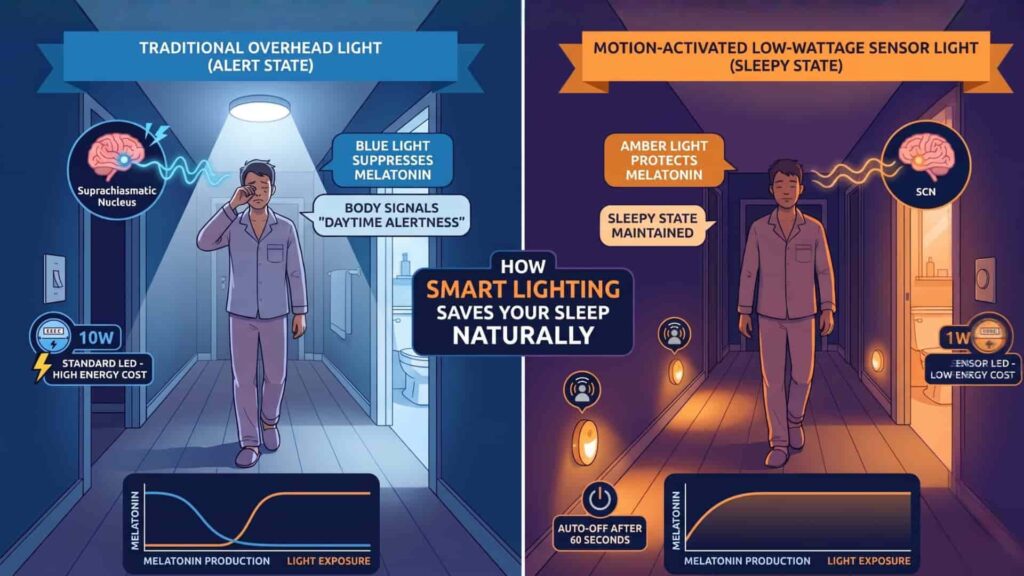
The physiological relationship between the human body and the daily cycle of light and dark has been meticulously forged over millions of years of evolution. Until the advent of artificial lighting approximately two centuries ago, human circadian biology was entirely synchronized with the solar day. The introduction of widespread electric illumination abruptly altered this evolutionary equilibrium. Today, modern society operates within an environment of ubiquitous artificial light at night (LAN), leading to chronic circadian misalignment, sleep fragmentation, and profound downstream metabolic and cognitive consequences. For those seeking to optimize their nocturnal environment, discovering how to Protect Your Sleep Naturally has become an essential pillar of long-term health.
To address the growing epidemic of Circadian Rhythm Sleep-Wake Disorders (CRSWD), the integration of motion sensor LED technology into residential architecture has emerged as a frontline intervention. By automating low-intensity, wavelength-calibrated illumination, these devices allow individuals to navigate their environments during nocturnal awakenings without triggering the biological signals that induce daytime alertness. This exhaustive report dissects the chronobiological mechanisms of light perception, the physics of LED spectrums, the engineering behind motion detection, and the economic variables of implementing smart lighting within the Indian residential market.
The Neuroanatomy of Circadian Rhythms and Photic Input
At the core of human sleep regulation is the circadian rhythm, a near-24-hour internal biological clock that governs metabolic, endocrine, and behavioral processes. Understanding the neuroanatomy of circadian rhythms is the first step to Protect Your Sleep Naturally. The master pacemaker of this circadian system resides in the suprachiasmatic nucleus (SCN), a small region located in the anterior hypothalamus comprising approximately 20,000 neurons.
The structural and functional division of the SCN is highly specialized to process different environmental cues:
- The Core: Primarily composed of vasoactive intestinal peptide (VIP) expressing cells, the core is the direct recipient of photic (light) input from the retina, synchronizing the internal clock with the external world.
- The Shell: Characterized by arginine vasopressin (AVP) expressing cells, the shell integrates non-photic inputs from the cortex, basal forebrain, and other hypothalamic structures, modulating the rhythm based on behavior and temperature.
Intrinsically Photosensitive Retinal Ganglion Cells (ipRGCs)
For decades, the scientific consensus held that the eye’s visual photoreceptors—rods and cones—were solely responsible for all light detection. However, modern chronobiology has identified a specialized, non-image-forming system mediated by intrinsically photosensitive retinal ganglion cells (ipRGCs). These unique cells utilize a distinct photopigment known as melanopsin, which acts as a primary irradiance detector for the brain.
When light enters the eye, melanopsin-containing ipRGCs transmit irradiance signals directly to the SCN via the retinohypothalamic tract (RHT). This photic signaling pathway bypasses the visual cortex entirely. In addition to the SCN, these cells project to the olivary pretectal nucleus (OPN), the intergeniculate leaflet (IGL), and limbic mood-regulating centers like the amygdala and the lateral habenula.
The Mechanism of Melatonin Suppression
Through the RHT, the SCN receives environmental light data and subsequently sends inhibitory projections to the paraventricular nucleus, which controls the pineal gland via the sympathetic nervous system. The pineal gland is responsible for synthesizing and secreting melatonin, the endogenous hormone that signals scotoperiod (nighttime) to the body, lowering core temperature and facilitating sleep onset.
Exposure to light during the subjective biological night halts the secretion of melatonin. A study demonstrated that exposure to standard indoor room light before bedtime suppresses melatonin onset in 99% of individuals, reducing overall melatonin duration by approximately 90 minutes. When individuals turn on a standard overhead light during a nocturnal bathroom visit, the ipRGCs immediately register the sudden influx of photons, interpreting it as dawn and instantly blunting the nocturnal melatonin curve.
The Pathophysiological Dangers of Artificial Light at Night (LAN)
The consequences of inappropriate nighttime illumination extend far beyond transient sleepiness. The dysregulation of the SCN and the suppression of melatonin have cascading effects on global adaptive physiology, immune function, and endocrine stability.
Acute Cognitive Arousal and Phase Shifting
Laboratory research consistently demonstrates that exposure to bright light acutely improves subjective and objective alertness, enhances high-frequency EEG brain wave activity, and reduces reaction times. While highly beneficial during the day, this arousal mechanism is disastrous at night. Even brief exposure to ordinary room light (~200 to 380 lux) during normal sleep hours can suppress melatonin synthesis by more than 50%.
Furthermore, brief flashes of light can cause a phenomenon known as a “phase shift.” Depending on the exact timing, exposure to light in the early subjective night delays the circadian clock (making it harder to fall asleep the next night), while light in the late subjective night advances the clock (causing premature awakening). Notably, research indicates that under certain conditions, intermittent flashes of bright light on the millisecond scale can trigger circadian phase shifts larger than those caused by continuous light exposure.
Systemic Health and Cardiovascular Implications
Chronic exposure to artificial light during evening hours artificially extends the photoperiod, placing modern humans in a state of continual “biological summer”. Because melatonin operates as a broad-spectrum physiological regulator—modulating body temperature, blood pressure, immune function, and lipid metabolism—its chronic suppression carries severe penalties.
Recent epidemiological data highlights the severe cardiovascular risks associated with nighttime light exposure. A landmark 2025 study utilizing data from the UK Biobank tracked over 100,000 participants using biosensor-loaded wristwatches. The findings revealed that individuals subjected to the highest levels of nighttime light exposure experienced up to a 50% increased risk of developing cardiovascular disease, including heart attack, stroke, atrial fibrillation, and coronary artery disease. The researchers emphasized that the damage was not solely derived from sleep deprivation, but rather from the fundamental disruption of the master circadian clock’s ability to regulate organ function. To mitigate these profound health risks, implementing interventions that Protect Your Sleep Naturally is no longer a luxury, but a medical necessity.
The Physics of Light: Spectrum, Wavelength, and Intensity
To optimize the residential nocturnal environment, it is imperative to distinguish between the visual intensity of light (measured in lux or lumens) and its spectral composition (measured in nanometers or Kelvin color temperature). Selecting the correct position on the visible light spectrum is paramount if you want to Protect Your Sleep Naturally.
The Spectral Sensitivity of Melanopsin
Melanopsin is not uniformly sensitive to all visible light. Research demonstrates that human non-image-forming photic responses are most powerfully triggered by short-wavelength blue light. Specifically, the peak sensitivity for melatonin suppression occurs at approximately 460 nm to 480 nm.
In previous decades, the accepted threshold for blue-light melatonin suppression was believed to be roughly 12 log photons cm−2 s−1. However, refined precision protocols have recently revealed that the threshold for human melatonin suppression is significantly lower, occurring at merely ~10 log photons cm−2 s−1 at 460 nm. This confirms that even trace amounts of blue light—such as the standby glow from a television or the unfiltered backlight of an LED clock—can initiate neurophysiologic arousal.
Wavelength Comparisons for Sleep Hygiene
The spectral diet consumed during the evening hours determines sleep latency and quality. Analyzing the varying effects of color spectrums yields clear guidelines for nocturnal illumination:
- Blue Light (450 nm – 490 nm): Emitted aggressively by fluorescent tubes, standard cool-white LEDs (6500K), and digital screens. Blue light provides the strongest “daytime” signal to the SCN, suppressing melatonin up to twice as long and shifting circadian timing twice as much as green light at similar intensities.
- Green Light (~500 nm – 550 nm): While less disruptive than blue, green light still notably decreases drowsiness and curtails melatonin production.
- Amber and Yellow Light (~570 nm – 590 nm): These warmer tones sit further away from melanopsin’s peak sensitivity. They have minimal effect on the circadian clock and are highly recommended for evening ambient lighting.
- Red Light (620 nm – 700 nm): Situated at the far end of the visible spectrum, red light possesses zero ability to trigger melanopsin. Studies confirm that 14 days of nightly red light exposure successfully elevated serum melatonin levels and improved sleep quality without compromising nighttime visibility.
The Intensity Paradigm: 1W vs. 10W
While wavelength is the primary driver of circadian disruption, light intensity (illuminance) remains a potent secondary variable. High-intensity indoor light (e.g., 100 to 500 lux) will suppress melatonin regardless of its color temperature. An overhead 10W to 14W LED bulb (equivalent to a 60W to 100W incandescent) produces roughly 900 to 1260 lumens, which is sufficient to drastically alter sleep architecture.
Conversely, a 0.5W to 1W LED night light generates a highly localized, low-intensity glow that provides enough visual acuity to navigate physical obstacles without surpassing the 10 log photons cm−2 s−1 threshold required to awaken the SCN. Utilizing a 1W fixture that specifically emits amber or red light provides a biophysically safe envelope for nocturnal wayfinding, leveraging longer wavelengths to Protect Your Sleep Naturally.
Table 1: Spectral Comparison of Common Lighting Colors on Sleep Physiology
| Color Spectrum | Wavelength Range (nm) | Circadian Impact | Melatonin Suppression Rate | Recommended Use Case |
|---|---|---|---|---|
| Blue | 450 – 490 nm | Severe Disruption | Highest (Peak at 460-480nm) | Daytime alertness, Office environments |
| Green | 500 – 550 nm | Moderate Disruption | High | Avoid entirely during evening hours |
| Yellow/Amber | 570 – 590 nm | Minimal Disruption | Low | Evening ambient lighting (Post-sunset) |
| Red | 620 – 700 nm | Zero Disruption | None | Nocturnal navigation, Night lights |
The Mechanics of Motion Sensor LED Technology
While swapping overhead bulbs for low-wattage, warm-spectrum alternatives is beneficial, manual light switches present a secondary physiological barrier to sleep maintenance. The act of waking up, standing, and actively searching for a light switch in the dark requires an elevation in cognitive vigilance and physical arousal. By removing the need for manual interaction, automated systems operate silently in the background to Protect Your Sleep Naturally.
Sensor Modalities: PIR vs. Microwave Radar
Modern smart lighting and sensor night lights rely primarily on two detection technologies to identify human presence:
- Passive Infrared (PIR) Sensors: PIR sensors detect the infrared radiation (body heat) emitted by humans or animals moving across their field of view. Because they rely on temperature differentials, PIR sensors are highly directional and require a clear line of sight. They are exceptionally power-efficient and are the standard for battery-operated or USB-rechargeable night lights.
- Microwave/Radar Sensors: Radar sensors emit continuous high-frequency electromagnetic waves and measure the reflection that bounces back. When a moving object alters the wave frequency (the Doppler effect), the sensor triggers the light. Radar sensors are incredibly sensitive; they can detect motion through thin walls, glass, or plastic fixtures, offering 360-degree coverage. However, they are more prone to false triggers (e.g., curtains moving in the wind) compared to PIR variants.
Automated Extinction and Sleep Fragmentation
A crucial feature of motion sensor lighting is the automated time-delay extinction. Standard sensor bulbs are programmed to maintain illumination only while motion is detected, subsequently turning off automatically after a preset duration—typically 30 to 60 seconds of inactivity.
If a standard bathroom light is left on accidentally, the ambient light bleed into the bedroom can penetrate the eyelids, disrupting rapid-eye-movement (REM) and slow-wave sleep stages throughout the remainder of the night. Motion-activated lighting completely eliminates the risk of “forgotten lights,” ensuring the environment rapidly returns to absolute darkness the moment the individual returns to bed.
Strategic Spatial Integration and Placement Metrics
To maximize both safety and circadian protection, the spatial placement of motion sensor lights must be meticulously planned. Poor placement can result in agonizingly bright glares directly into the eyes or constant false triggers that disrupt sleep. Strategic spatial mapping of these devices is a highly effective way to Protect Your Sleep Naturally by ensuring illumination is strictly limited to transit zones.
Optimal Placement Zones for Easy Understanding
- Under-Bed Perimeters: Utilizing magnetic, USB-rechargeable LED motion sensor strips mounted directly under the bed frame is highly effective. As soon as an individual swings their feet over the mattress, the floor is illuminated with a gentle, indirect glow. This setup entirely bypasses direct retinal exposure.
- Hallways and Corridors: Placing sensors low to the ground in hallways creates an illuminated “runway” to the bathroom. If utilizing wall-mounted fixtures, experts recommend a height of six to eight feet to achieve a bird’s-eye 360-degree view, provided the light is angled downward.
- Bathrooms and Powder Rooms: The bathroom is the most critical intervention point. A 2010 study proved that exposure to standard white bathroom lighting for just 30 minutes before bed significantly depressed melatonin levels. Replacing the primary bathroom bulb with a dual-sensor (PIR + Lux sensor) prevents blinding light exposure during 3:00 AM visits.
- Staircases: Installing discrete, warm-light sensor pods along stair treads mitigates the fear of falling. Clinical studies have noted that low-level lighting during nocturnal ambulation improves postural stability and spatial awareness among the elderly without inducing sleep disruptions.
Placement Configurations to Avoid
- Directly Across from the Bed: Sensors should not have a direct line of sight to a sleeping individual, as tossing and turning can trigger the light, causing repeated micro-awakenings.
- Near Thermal Disruptors: PIR sensors interpret rapid temperature changes as movement. Placing them near heating vents, radiators, air conditioners, or windows with heavy drafts will cause false activations.
- Top of the Stairs (If Pet Owners): For households with cats or dogs, sensors placed at the top of staircases can be easily triggered by roaming pets, illuminating adjacent bedrooms unnecessarily.
Economic and Environmental Optimization: The Indian Context
Beyond the vast biological advantages, replacing traditional incandescent or standard manual LEDs with motion sensor variants presents a compelling financial argument, particularly within the Indian power grid. Transitioning to automated micro-wattage is a financially sound strategy to Protect Your Sleep Naturally.
Power Tariffs and the Slab-Based System in India
Lighting accounts for roughly 15% to 20% of a standard household’s total electricity bill. Electricity billing in Indian states predominantly operates on a “telescopic slab” system. As a household consumes more units (kWh), the rate applied to those upper-tier units increases significantly.
For example, in Delhi (FY 2024-2025), the energy charge begins at ₹3.00 per kWh for the first 200 units, climbs to ₹6.50 for 401-800 units, and peaks at ₹8.00 per kWh for usage exceeding 1200 units. Similarly, in Tamil Nadu, domestic rates range from ₹4.95 for low consumption up to ₹11.05 per kWh for high consumption. On a national level, the average residential electricity price sits at approximately ₹6.490 per kWh.
Consumption Calculation: Manual vs. Automated
Traditional incandescent bulbs waste up to 90% of their consumed energy as heat. While modern LEDs mitigate this by using a semiconductor to convert electricity directly into light, a manual LED left on accidentally still incurs unnecessary costs.
Consider a standard scenario where a nightlight is required for hallway and bathroom navigation:
- Annual Consumption (9W LED): A standard 9W LED bulb left on overnight (roughly 8 hours) consumes 72 watt-hours (Wh) per night. Annually, this equals 26.28 kWh. At an average tariff of ₹8.00 (assuming mid-to-high slab), this single bulb costs ₹210.24 annually.
- Annual Consumption (1W Sensor): A 1W PIR motion sensor night light activates only when necessary. If triggered 6 times a night for 1 minute each, its active operating time is merely 6 minutes per night. Annually, this equals 0.0365 kWh. At an average tariff of ₹8.00, this sensor light costs a negligible ₹0.29 annually.
When extrapolated across a 3-bedroom Indian apartment featuring 5 to 6 navigational night lights, the financial divergence becomes stark. Furthermore, preventing standard 14W or 20W bathroom lights from being accidentally left on for hours translates to massive aggregate savings over the lifespan of the property.
Table 2: Comparative Annual Energy Cost in India (Per Bulb) (Assuming a high-tier rate of ₹8.00 per kWh to illustrate maximum impact)
| Bulb Type | Wattage | Daily Usage | Annual Power Consumption (kWh) | Estimated Annual Cost (INR) |
|---|---|---|---|---|
| Incandescent | 60W | 8 Hours | 175.20 kWh | ₹ 1,401.60 |
| Standard LED | 9W | 8 Hours | 26.28 kWh | ₹ 210.24 |
| Sensor LED | 1W | 6 Minutes | 0.0365 kWh | ₹ 0.29 |
Market Analysis: Leading Motion Sensor LEDs in India (2025-2026)
The Indian e-commerce landscape offers a robust variety of motion sensor lighting solutions tailored to different architectural needs and budgets. Through careful brand selection on platforms like Flipkart and Amazon, consumers in India can effectively Protect Your Sleep Naturally using readily available smart devices.
Smart B22 Bulbs (Overhead/Socket Replacement)
The standard domestic light socket in India is the B22 (Bayonet mount). Several top-tier electronic manufacturers produce radar and PIR sensor bulbs designed as direct, screw-in replacements for these sockets.
- Philips Lighting: Philips offers premium 9W and 14W B22 motion-sensing LED bulbs that produce 1260 lumens. Utilizing an advanced microwave radar sensor, the Philips models detect movement within a 6-meter radius and feature a 60-second auto-off timer. These are generally priced between ₹399 and ₹417 per bulb, offering exceptional reliability.
- Wipro Garnet: Wipro provides a highly competitive 9W B22 motion sensor bulb. With an output of 900 lumens, the Wipro model features a robust polycarbonate shell and is often sold in bulk packs (e.g., ₹844 to ₹860 for single units or bundled pricing).
- Halonix & Orient: Halonix offers a unique “Radar + Lux Sensor” B22 bulb ranging from 10W to 20W (priced at ₹299 to ₹399). The addition of a lux (ambient light) sensor ensures the motion detector only triggers the light when the room is actually dark, saving further energy. Orient Electric also provides round 10W sensor bulbs at competitive discount prices (~₹188).
Wireless Magnetic & USB Rechargeable Strips
For applications where hardwiring or socket availability is limited (such as under cabinets, inside wardrobes, or beneath bed frames), battery-operated magnetic strips are the optimal choice.
- Premium Strips: Brands like Dwarkesh and Shivay Creation offer 30cm to 50cm magnetic LED strips powered by rechargeable lithium-ion batteries via USB. The Shivay Creation strip features 3 color modes, allowing users to select a warm, sleep-friendly amber tone, priced around ₹999. The Dwarkesh 30cm model retails for approximately ₹1499.
- Budget Wall Pucks: For compact, modular placements, brands like DandT and UNITIX offer small, USB-rechargeable wireless sensor wall lights. These puck-style lights are ideal for bathrooms and camping, typically retailing between ₹799 and ₹956. Other highly economical options include plug-in ambient sensors from BlackT Electrotech, operating directly via 220V AC wall sockets for as little as ₹260 to ₹380.
Table 3: Motion Sensor LED Bulb & Strip Market Comparison (India)
| Brand & Model | Type / Fitting | Wattage | Sensor Tech | Features | Approx. Price (INR) |
|---|---|---|---|---|---|
| Philips Motion Sensing | B22 Socket Bulb | 14W | Radar | 6m range, 60s auto-off, 1260lm | ₹ 399 – ₹ 417 |
| Wipro Garnet | B22 Socket Bulb | 9W | Radar | Polycarbonate, 900lm | ₹ 844 |
| Halonix Ambience | B22 Socket Bulb | 10W-20W | Radar + Lux | Daylight sensing override | ₹ 299 – ₹ 399 |
| Shivay Creation | Magnetic Strip | – | PIR (Infrared) | USB rechargeable, 3 Color modes | ₹ 999 |
| DandT / UNITIX | Wall Puck | – | PIR (Infrared) | Wireless, USB rechargeable | ₹ 799 – ₹ 956 |
| BlackT Electrotech | Wall Plug-in | <1W | PIR (Infrared) | Direct AC plug, Low intensity | ₹ 260 – ₹ 380 |
Synergistic Sleep Hygiene Protocols
While the physical engineering of light via motion-activated LEDs solves the immediate problem of nocturnal awakenings, it is but one component of comprehensive environmental design. The circadian pacemaker relies on multiplexed signals. Therefore, lighting modifications should be paired with thermoregulatory practices for maximum efficacy.
Core Thermoregulation
Just as the body relies on darkness to release melatonin, it relies on a drop in core body temperature to facilitate sleep onset. Clinical studies indicate that a warm shower (38-40ºC) approximately one to two hours before bedtime acts as a powerful sleep aid. The external heat promotes peripheral vasodilation (pushing blood flow to the hands and feet), which paradoxically accelerates the cooling of the body’s internal core. This thermal drop is a primary physiological signal for sleep. Ensuring that the bathroom environment during this shower is lit by warm, dim lighting—rather than harsh overhead 6500K LEDs—prevents the suppression of melatonin during this critical wind-down phase.
Blue-Light Blocking Eyewear
In modern environments where total control over ambient lighting is impossible (e.g., living with roommates, working late shifts, or interacting with digital screens), blue-light blocking glasses provide a supplementary, non-pharmacological defense. Spectacles engineered with deep orange-tinted lenses effectively absorb the 400 nm to 500 nm wavelengths emitted by smartphones and televisions. By artificially imposing a scotopic (dark) spectral environment onto the retina, these lenses permit normal melatonin synthesis to occur even in brightly lit rooms, functioning as a wearable shield against circadian disruption.
Sunrise Simulation and Morning Entrainment
The circadian rhythm is anchored not just by the absence of light at night, but by the presence of bright light in the morning. Morning light exposure triggers healthy cortisol spikes and synchronizes the biological clock for the upcoming 24 hours. For individuals living in light-deprived environments, utilizing a wake-up light that simulates a natural sunrise (gradually increasing yellow/white light intensity over 30 minutes) offers a gentler, biologically aligned alternative to jarring auditory alarms. This dual approach—restricting blue light at night while maximizing it upon waking—creates a robust circadian amplitude.
Conclusion
The eradication of natural darkness by modern electric infrastructure represents a profound challenge to human biology. The suprachiasmatic nucleus, calibrated over millennia to respond to the precise rotational cycles of the Earth, is easily deceived by the brilliant, short-wavelength emissions of standard household lighting. The downstream consequences of this neuroendocrine deception manifest in fragmented sleep architecture, suppressed melatonin, delayed phase shifts, and a measurably increased risk of cardiovascular and metabolic morbidities.
Through the strategic implementation of targeted environmental technologies, these biological pitfalls can be bypassed. Motion sensor LED lights provide a seamless intersection of chronobiology and electrical engineering. By utilizing long-wavelength (amber or red) spectrums, low-wattage outputs, and automated hands-free activation mechanisms (PIR or radar), these devices grant safe nocturnal navigation without inciting the physiological arousal associated with daylight.
Furthermore, the economic rationale for adopting this technology within India is self-evident. Driven by the efficiency of automated time-delays and fractional wattage consumption, motion sensor night lights virtually eliminate the electricity costs associated with nocturnal lighting. From both a neurobiological and a financial standpoint, the optimization of the residential lighting grid is a mandatory step in modern sleep hygiene. Ultimately, deploying automated, spectrum-calibrated illumination remains one of the most accessible and effective methods to Protect Your Sleep Naturally.