

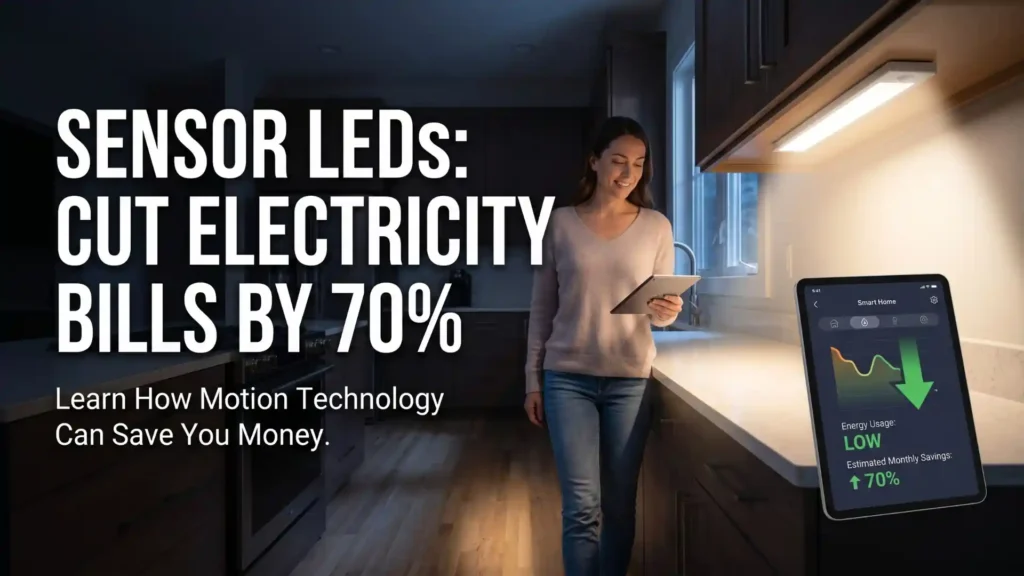
The global transition toward sustainable energy management has placed an unprecedented focus on building efficiency, given that the built environment is responsible for approximately 40% of global energy consumption. Within this matrix, artificial illumination represents a substantial operational load, particularly in developing economies experiencing rapid urbanization. The deployment of Sensor LEDs represents a paradigm shift in how residential and commercial infrastructure manages power consumption. By integrating solid-state illumination with advanced environmental detection mechanisms, these systems ensure that power is utilized exclusively when required, thereby mitigating the chronic wastage associated with human error and manual switching.
Historically, energy conservation in illumination focused purely on increasing luminous efficacy—the transition from incandescent filaments to compact fluorescent lamps (CFLs), and ultimately to solid-state lighting. However, an estimated 65% of installations fail to capture an additional 25% to 35% in potential energy savings due to a lack of automated optimization. By addressing the time-of-use variable, automated lighting solutions dramatically alter the consumption equation. This comprehensive report explores the technological foundations, economic modeling, spatial deployment strategies, and macroeconomic impacts of automated lighting, with a specific focus on the Indian domestic and commercial markets.
The Macroeconomics of Electricity Consumption in India
To understand the financial imperatives driving lighting automation, it is essential to analyze the structural economics of the Indian power sector. The average electrified Indian household consumed approximately 90 units (kWh) of electricity per month in 2014, a figure that has risen steadily in tandem with increasing appliance ownership and rising living standards. During peak evening hours, lighting contributes to an estimated 12% of the total connected load in an urban household, excluding common area lighting in apartment complexes, which adds an additional 8%.
The economic burden of inefficient lighting is directly tied to the retail tariff rates set by State Electricity Regulatory Commissions. India employs a slab-based tariff system, penalizing high consumption with exponentially higher rates per kilowatt-hour.
| State | Approx. Residential Tariff (₹/kWh) | Commercial Tariff (₹/kWh) | Industrial Tariff (₹/kWh) |
| Delhi | ₹3.00 (0–200 units) to ₹8.00 (>1200 units) | ₹8.00 | ₹8.00 – ₹8.02 |
| Maharashtra | ₹4.43 – ₹12.83 (slab-based) | ₹16.97 | ₹10.88 |
| Uttar Pradesh | ₹3.35 – ₹6.50 | ₹5.75 – ₹8.60 | Not specified |
| Gujarat | ₹7.00 – ₹10.00+ | ₹10.50 | ₹7.52 |
| Tamil Nadu | ₹4.95 (subsidized lower slabs) | ₹8.80 | ₹6.00 |
Data derived from current tariff estimations and distribution company reports.
In high-tariff regions such as Maharashtra, where residential rates can surge past ₹12.83 per unit and commercial rates approach ₹16.97 per unit, the financial drain of continuously operating unoptimized lighting is severe. Reducing the operational hours of a lighting circuit through automation provides a disproportionately high return on investment by keeping total household consumption in the lower, cheaper billing slabs.
Technological Evolution: From Incandescent to Solid-State
The fundamental mechanism of generating light has undergone a massive technological shift over the past two decades. Understanding the baseline efficiency is critical before calculating the benefits of automation.
- Incandescent Bulbs: The thermal radiation method utilized by incandescent bulbs relies on heating a tungsten filament until it glows. This process is inherently inefficient, producing approximately 16 lumens per watt (lm/W), meaning that a standard 700-lumen output requires 60 watts of electrical power.
- Compact Fluorescent Lamps (CFLs): A CFL requires only 15 watts to generate 700 lumens (approximately 70 lm/W). However, CFLs present severe environmental and operational drawbacks. They contain 1mg to 5mg of highly toxic mercury and suffer from drastic lifespan reductions if subjected to frequent on/off cycling, making them completely incompatible with motion detection systems.
- Solid-State Lighting: Semiconductors convert electricity directly into photons, yielding efficacies of 89 to over 120 lm/W. A modern solid-state bulb requires merely 8 to 9 watts to achieve the same 700-lumen benchmark.
| Lighting Technology | Efficacy (Lumens/Watt) | Power for 700+ Lumens | Average Lifespan | Environmental Hazard | On/Off Cycling Impact |
| Incandescent | 16 lm/W | 60 W | 1,000 hrs | High CO2 footprint | No Effect |
| CFL | 70 lm/W | 14-15 W | 10,000 hrs | Toxic Mercury | Severe Lifespan Reduction |
| Solid-State | 89 – 120+ lm/W | 8-9 W | 25,000 – 30,000 hrs | RoHS Compliant | No Effect |
Data aggregated from lighting performance benchmarks.
The Bureau of Energy Efficiency (BEE) in India has rigorously promoted this baseline technology through the UJALA scheme, distributing over 36.5 crore units and slashing national carbon dioxide emissions by 3.85 crore tons annually.
Decoding the Mechanics of Occupancy Detection
Understanding how Sensor LEDs detect occupancy requires looking beyond basic diode efficiency and examining the embedded microelectronics. Unlike rudimentary timer-based systems, these smart fixtures incorporate sophisticated hardware that maps the physical environment and responds dynamically to stimuli.
To maximize operational efficiency, consumers must select the correct underlying sensor technology for their specific spatial requirements:
- Passive Infrared (PIR) Technology: PIR technology is the industry standard for residential indoor applications. These devices are passive, meaning they do not emit energy. Instead, they feature pyroelectric elements that detect changes in infrared radiation, specifically the heat signatures emitted by human bodies.
- Power Consumption: Extremely low, generally consuming between 0.8 and 1.0 Watt in standby mode.
- Ideal Application: Indoor spaces with clear lines of sight, such as living rooms and standard corridors. They are highly immune to non-living movement, such as curtains blowing in the wind.
- Microwave Radar Technology: These sensors operate on active radar principles. They continuously emit high-frequency electromagnetic radio waves (typically at 5.8 GHz) and measure the reflection as it bounces back from surfaces. If a moving object enters the field, it alters the frequency of the returning waves—a phenomenon known as the Doppler shift.
- Power Consumption: Marginally higher, drawing between 1.1 and 1.5 Watts continuously.
- Ideal Application: Enclosed outdoor fixtures, frosted glass housings, and large commercial spaces. Because microwaves penetrate low-density materials like thin walls and wood, the hardware can be entirely concealed within the fixture.
- Ultrasonic Wave Technology: Operating similarly to microwave variants, these utilize high-frequency sound waves. They excel in spaces with physical obstacles, such as public restrooms with stall partitions, as the sound waves fill the volumetric space rather than relying on a direct line of sight.
The Mathematics of Savings: Achieving the 70% Benchmark
The financial argument for Sensor LEDs becomes irrefutable when we factor in the time-of-use variable. The proposition that utility costs can be reduced by 70% or more relies on mathematical synergy: compounding the baseline hardware efficiency of solid-state technology with the drastic reduction in operational hours provided by automation.
Consider a residential staircase, parking garage, or common corridor where illumination is traditionally left active from 6:00 PM to 6:00 AM (12 hours).
Scenario A: Traditional Incandescent Approach
- Fixture: 60W Incandescent.
- Daily Usage: 12 hours.
- Daily Energy Consumption: 60 W × 12 h = 720 Wh (0.72 kWh).
- Annual Energy Consumption: 0.72 kWh × 365 = 262.8 kWh.
Scenario B: Standard Solid-State Upgrade
- Fixture: 9W standard solid-state bulb.
- Daily Usage: 12 hours (still left on all night due to human behavior).
- Daily Energy Consumption: 9 W × 12 h = 108 Wh (0.108 kWh).
- Annual Energy Consumption: 0.108 kWh × 365 = 39.42 kWh.
- Savings vs. Incandescent: 85%.
Scenario C: The Automated Solution
- Fixture: 9W automated fixture equipped with a microwave detector (consuming 1.2W on standby).
- Actual Occupied Time: 1.5 hours total throughout the night (triggered intermittently by movement).
- Active Energy Consumption: 9 W × 1.5 h = 13.5 Wh.
- Standby Energy Consumption: 1.2 W × 22.5 h = 27 Wh.
- Total Daily Energy Consumption: 13.5 Wh + 27 Wh = 40.5 Wh (0.0405 kWh).
- Annual Energy Consumption: 0.0405 kWh × 365 = 14.78 kWh.
Comparing the automated solution directly to the legacy 60W fixture reveals a staggering 94.3% reduction in power drawn by that specific circuit. Even when compared to a standard 9W upgrade, the integration of automation yields an additional 62.5% reduction in power draw.
Replacing traditional fixtures with Sensor LEDs ensures your home stays in the lower, cheaper billing slabs. Across an entire residential footprint, factoring in high-traffic zones like kitchens, bathrooms, and hallways where lights are frequently forgotten, the aggregate electricity bill for illumination is easily slashed by the 70% benchmark.
Evaluating the Indian Market: Top Brands and Specifications
The domestic market for Sensor LEDs has expanded dramatically, offering solutions that do not require external wiring or professional installation. These consumer-ready integrated units contain the driver, the light-emitting diodes, and the microwave or PIR detector within a single standard B22 or E27 housing.
While these units carry an initial procurement premium (ranging from ₹300 to ₹995) compared to a standard ₹100 unautomated bulb, the guaranteed 6 to 12-month return on investment (ROI) via slashed utility bills makes them a highly lucrative infrastructural upgrade.
Key Industry Players
- Philips Lighting (Signify): A market leader offering the 14W Motion Sensing Round B22 Bulb. Operating at 6500K (Crystal White) and delivering 1260 lumens, this fixture features an integrated human detection system that switches off automatically after 60 seconds of vacancy. Retail pricing fluctuates between ₹387 and ₹399 depending on bulk purchasing. Consumer reviews indicate high satisfaction with brightness, though some users report malfunctioning detection hardware in extremely humid conditions.
- Halonix: Recognized as the pioneer in bringing integrated radar bulbs to the Indian market. Their 10W Radar model utilizes microwave technology, making it highly sensitive and capable of detecting motion through thin obstructions. This makes it ideal for enclosed verandas or fixtures with frosted glass covers.
- Wipro (Garnet): Wipro’s smart portfolio, priced around ₹700, includes programmable features via the Wipro Next Smart Home App. These Wi-Fi-enabled fixtures allow users to synchronize lighting with daily routines, offering both localized motion detection and remote scheduling.
- Orient: Orient manufactures competitive 9W and 10W auto-on/off fixtures noted for accurate detection and balanced light spread, making them highly suitable for open balconies and staircases.
When evaluating top-tier Sensor LEDs, consumers should prioritize sensor type over mere wattage. A high-quality microwave radar unit from Halonix will perform vastly differently in an outdoor enclosed porch than a standard PIR unit, which may fail to activate if placed behind glass.
Optimal Placement and Vastu Shastra Integration
Procuring the appropriate hardware is only a fraction of the solution; architectural integration dictates operational success. Incorrect placement leads to high rates of false negatives (failing to activate) or false positives (activating when unoccupied), which degrades the user experience and nullifies energy savings.
Sensor Placement and Mounting Calibration
The functional geometry of an occupancy detector is determined by its mounting height and viewing angle. Industry standards dictate a mounting height of 7 to 9 feet from the floor for the optimal balance between accuracy and area coverage. If placed higher than 10 feet, the focal point disperses, creating dead zones directly beneath the fixture.
Integrating Sensor LEDs within the spatial framework of Vastu Shastra requires an understanding of directional energies. Historically, homeowners struggled to reconcile modern electrical automation with ancient spiritual guidelines. Today, advanced programmable technology allows for seamless alignment.
- North and East Zones (Water/Clarity): These areas demand soft, natural, and daylight-mimicking illumination (5000K – 6500K). Automation should be programmed to bring these lights to full brightness during morning hours, aligning with the circadian rhythm and the rising sun.
- South-East Zone (Fire/Agni): The domain of Agni, where kitchens are typically located. Task lighting is essential here, and the color temperature should be warm (2700K – 3000K). Utilizing automated shut-offs here ensures safety, turning off high-heat appliances or bright task lights when the kitchen is vacant.
- North-West Zone (Movement): Associated with movement and air, this is the ideal architectural placement for dynamic lighting triggers and security cameras.
- Brahmasthan (The Center): The energetic core of the home must remain open and clutter-free. Heavy lighting fixtures or massive smart hubs should be avoided.
Wall-mounted Sensor LEDs are best calibrated at 6.5 to 8 feet to avoid false triggers from small pets. Standard PIR detectors read heat mass. By angling the lens slightly downward at this height, the focal rays pass over the floor level where a 15kg dog might roam, preventing the system from cycling on unnecessarily.
Troubleshooting Common System Vulnerabilities
Despite their robust nature, automated Sensor LEDs are susceptible to environmental and electrical interference. Addressing these vulnerabilities ensures sustained energy efficiency and prolongs the lifespan of the hardware.
When an automated fixture cycles on and off continuously throughout the night, it points to environmental interference or sensitivity miscalibration.
- Environmental Obstructions: Spiders building webs across the PIR lens, insects attracted to the heat sink, or overgrown vegetation moving in the wind can repeatedly trigger the system. Regular cleaning of the faceplates is required.
- HVAC Interference: Ultrasonic and PIR variants placed too close to air conditioning registers or ceiling fans will detect the rapid change in thermal currents or air pressure, causing false positives.
- Microwave Penetration: Because microwave variants emit 5.8 GHz radio waves that penetrate walls, a bulb installed in an exterior porch fixture may be continuously triggered by people walking inside the adjacent living room or vehicles passing on the street. In such cases, reducing the detection range or opting for a PIR unit instead is necessary.
Furthermore, Indian electrical grids are notorious for voltage fluctuations. Power surges can fry the sensitive microprocessors within the automated bulbs before the diodes themselves degrade. Faulty wiring or older electrical architectures that do not support the minimal load requirements of modern microelectronics can result in the lights flickering or remaining permanently illuminated.
Commercial Applications, Security, and Grid Stability
While residential utility reduction is a massive driver, the deployment of automated infrastructure in the commercial and industrial sectors yields dual benefits: operational cost suppression and physical security. In manufacturing plants, warehouses, and infrastructure projects, illumination is frequently left operational 24/7. Transitioning these high-bay and corridor fixtures to automated networks ensures that vast, unoccupied zones remain dark until a forklift or worker enters the perimeter, reducing commercial consumption by up to 60%.
The security advantage is equally profound. A static, continually illuminated exterior light provides an intruder with a clear map of a property’s layout and shadows. Conversely, a dark perimeter that instantly floods with high-lumen light the moment a perimeter is breached startles the intruder, signals an active security presence, and immediately draws the attention of guards or neighbors. Instant illumination acts as a primary psychological deterrent.
The aggregate impact of millions of households and businesses transitioning to optimized illumination has profound implications for national infrastructure. By automating this sector, the baseline load on fossil-fuel-dependent thermal power plants is permanently lowered. This reduces the requirement for highly expensive peaking power plants to come online during the 6:00 PM to 10:00 PM window. Consequently, carbon dioxide and sulfur oxide emissions are drastically curtailed, dropping the carbon footprint of a 30-bulb network from 4500 pounds of CO2 annually to under 451 pounds.
Ultimately, the nationwide adoption of Sensor LEDs offers a scalable, highly lucrative infrastructural upgrade capable of slashing associated electricity expenditures by an extraordinary margin. By eliminating human behavioral inefficiency through advanced microelectronics, consumers secure a rapid return on investment, enhance physical security, and contribute significantly to global environmental sustainability.